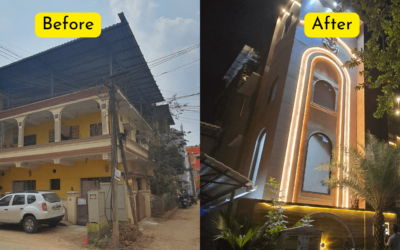
Plastering is a foundational civil engineering skill that protects masonry walls from weather degradation while providing a smooth, plumb, and uniform surface for luxury paint finishes. At Grihalaya Builders, our residential construction standards eliminate hollow spots, hairline shrinkage cracks, and debonding. Whether you are executing fresh home construction in Chennai or undertaking a complete building renovation, this guide explains how do you mix plaster, the 7 engineering rules on how to prevent plaster from cracking, and curing protocols as per Indian Standards.
How Do You Mix Plaster: Internal vs. External Mortar Proportions
Homeowners and site supervisors frequently ask how do you mix plaster to ensure maximum tensile adhesion without cracking. The mixing ratio must be tailored to whether the wall is internal or directly exposed to Chennai’s harsh sun and monsoon rains:
| Plaster Application | Cement : Sand Ratio | Recommended Thickness | Additives & Sand Grade |
|---|---|---|---|
| Internal Wall Plastering | 1:5 or 1:6 | 12mm (single coat) | Zone II Plastering M-Sand; smooth sponge finish |
| Ceiling Plastering | 1:3 or 1:4 | 6mm to 8mm (light coat) | Rich mortar to prevent sagging under gravity |
| External Wall Plastering (1st Coat) | 1:4 | 12mm rough base coat | Waterproofing compound (Dr. Fixit / Fosroc 200ml/bag) |
| External Wall Plastering (2nd Coat) | 1:4 or 1:5 | 8mm sand-faced finish | Coarse sand finish for weather shedding |
Step-by-Step Mixing Procedure:
- Dry mix the measured cement (OPC 43/53 or PPC) and silt-free plastering M-sand on a clean, non-absorbent mixing platform until color is completely uniform.
- Create a central crater (hollow) in the dry mix.
- Add clean, potable drinking water gradually (water-cement ratio between 0.50 and 0.55). For external plaster, dissolve liquid integral waterproofing compound in the mixing water first.
- Mix thoroughly with shovels for at least 3 to 5 minutes until a workable, cohesive, lump-free mortar paste is achieved.
- Only mix quantities that will be applied within 60 to 90 minutes. Never re-temper mortar that has already begun its initial set.
How to Prevent Plaster from Cracking: 7 Engineering Rules
Hairline cracks in plaster are among the most common complaints in residential construction. At Grihalaya Builders, we enforce 7 strict engineering measures to guarantee crack-free plastering:
- Install GI Chicken Wire Mesh at RCC-Brick Joints: Concrete and clay bricks have different thermal expansion coefficients. Install a 200mm (8-inch) wide galvanized iron (GI) wire mesh or fiberglass mesh centered across all column-to-brickwork and beam-to-brickwork junctions before plastering to absorb differential movement.
- Surface Hacking on RCC Members: Concrete columns, beams, and ceiling slabs are too smooth for mortar adhesion. Hack the concrete surface with chisels to produce at least 25 to 30 indentations (hacks) per square foot, followed by a cement bonding slurry coat.
- Rake Brickwork Joints: Ensure masonry joints were raked 10mm to 12mm deep during bricklaying. Smooth flush joints will cause the plaster coat to delaminate and crack.
- Pre-Wet the Masonry Walls: Saturate walls with clean water 2 to 3 hours before plastering. Dry masonry aggressively robs mixing water from plaster, causing plastic shrinkage crazing.
- Control Single-Coat Thickness: Never apply more than 15mm in a single coat. Excessively thick plaster sags under gravity and forms deep shrinkage fissures. For thick zones, apply in two distinct coats with a scratch key between them.
- Strict 14 to 21-Day Water Curing: Begin gentle water sprinkling 24 hours after application. Maintain continuous moisture for 14 to 21 days. Cement requires sustained hydration to reach tensile strength; skipping curing is the #1 cause of cracked plaster.
- Avoid Plastering in Direct Midday Sun: In Chennai’s scorching summer heat, rapid surface evaporation causes thermal shock. Use green shading nets on external scaffoldings during application.
Frequently Asked Questions: Plastering Best Practices
How do you mix plaster for interior and exterior walls?
For interior walls, mix 1 part cement to 5 or 6 parts plastering M-sand with a water-cement ratio of 0.50. For exterior walls, mix 1 part cement to 4 parts coarse M-sand and add 200ml of integral liquid waterproofing compound per 50kg cement bag. Always dry-mix first, add potable water gradually, and use within 60 to 90 minutes.
How to prevent plaster from cracking on walls and ceilings?
Prevent plaster cracks by: 1) Fixing GI chicken wire mesh across all RCC column/beam-to-brickwork junctions, 2) Hacking concrete surfaces to create mechanical keys, 3) Pre-wetting walls 2 hours prior, 4) Keeping thickness to 12-15mm maximum per coat, and 5) Curing with water continuously for 14 to 21 days as per IS 1661.
Why is chicken mesh installed at RCC-brick wall joints before plastering?
RCC concrete members and masonry bricks expand and contract at different rates under Chennai’s thermal variations. Chicken mesh (or fiberglass mesh) bridges the joint, distributing shear stresses and preventing unsightly linear cracks from tearing through the plaster surface.
How many days should newly plastered walls be cured with water in Chennai?
Newly plastered walls must be water-cured for a minimum of 14 days, and preferably 21 days in Chennai’s dry or summer seasons. Proper hydration develops the crystalline cement lattice, preventing dusting and shrinkage fissures.
What is the difference between sand-cement plaster and gypsum plaster?
Sand-cement plaster is moisture-resistant, robust, and essential for all exterior walls, wet areas (bathrooms/kitchens), and structural masonry. Gypsum plaster provides a super-smooth glass finish with zero water curing needed, but can only be used on completely dry interior walls and will dissolve if exposed to moisture.
Conclusion & Consultation
By following these best practices in plastering, you can ensure high-quality, crack-resistant results in your construction projects. For expert assistance with residential building or renovation in Chennai, explore our completed projects or contact Grihalaya Builders today for an engineering consultation.
Plastering specifications conform to IS 1661: Code of practice for application of cement and cement-lime plaster finishes.

Recent Comments